Core Concepts / Architecture
How the console works internally
PIXELFALLS compiles game data (code, sprites, maps, audio) into a single cart payload that is loaded at runtime.
Lifecycle Method
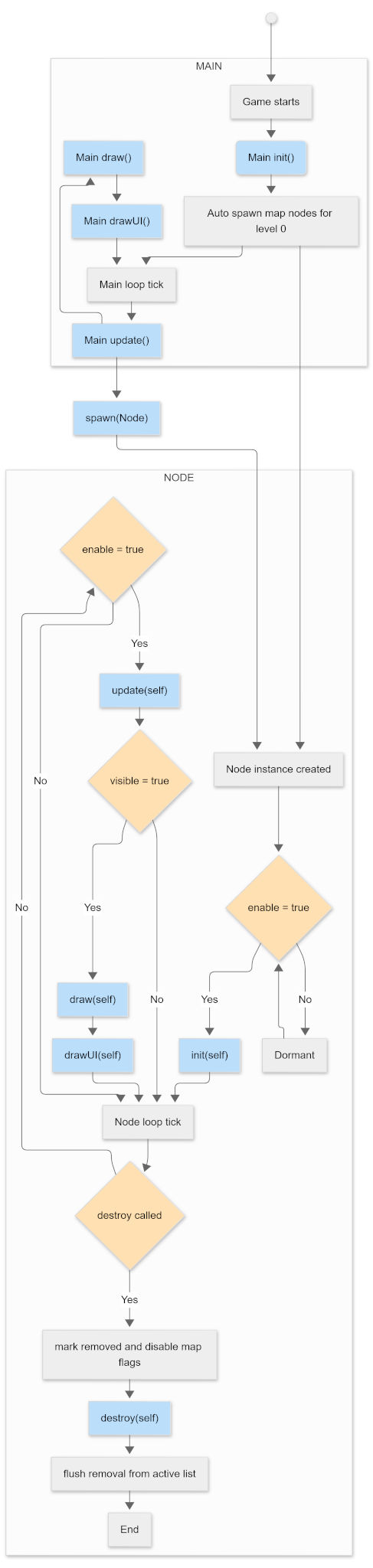
PIXELFALLS uses a small set of lifecycle methods that the runtime calls in a fixed order.
init()- Called Once when the game loads, and is a good place for startup logic.update()- Every Frame - put game logic, input handling, and movement in here.draw()- Every Frame - put drawing calls here.drawUI()- Every Frame - runs afterdraw()and is intended for HUD and other UI.destroy(self)- Nodes Only - Called once when the Node is destroy - but before its data is deleted.
If nodes are present, the main 'draw()' will be processed first, followed by all node 'draw()` methods, which are called using their z-order - lowest to highest.
Input system
Use buttonDown() and buttonPressed() with logical BTN_* constants (D-pad, A–D, L, R). Keyboard and standard game controllers map onto those buttons (D-pad or left stick, A/B/X/Y, shoulders). Start opens the engine pause menu, the same as Escape.
Player remapping UI to follow.
API design
APIs are intentionally fully named for easy reference and readable code.
Lifecycle Flow Diagram